Featured Post

Peace Corps Georgia Assignment: a Brief Summary 2014-2016

As I close out my Georgia Peace Corps Service 2014-2016 I would like to answer a few questions, and also summarize my service. It seems...

Showing posts with label Peace Corps Georgia. Show all posts

Tuesday, September 13, 2016

Peace Corps Georgia Assignment: a Brief Summary 2014-2016


As I close out my Georgia Peace Corps Service 2014-2016 I would like to answer a few questions, and also summarize my service. It seems like a daunting task, but Peace Corps thrives on qualitative and quantitative reporting, so I have at least had some practice. 

Questions that have surfaced from my supportive readers include:
What were my goals and what did I accomplish?
What was my daily routine?
Am I glad I did it?   
Personally what have I gained? and what plans for the future?

What were my goals and what did I accomplish?
It is most difficult to say what one ‘accomplished’ in any Peace Corps assignment.    The reason is that our job is to assist, support, enable, and facilitate our Georgian counterparts in what they try to accomplish. We are not supposed to lead but encourage, not to dictate but suggest, not to yell, but gently whisper. Personally it has been good training for me as my children grow and need support, but not by an authoritative mother figure. 

Also, it seems I spent more time on relationship building, integrating into the local culture, struggling to improve my language skills, and figuring out what and how to eat - which is all part of the Peace Corps experience.  But let me share what I have worked on. 

We have two programs in Georgia: the English education volunteers that support English teachers in the schools (EE), and the Individual/Organizational Development (IOD) volunteers. I am in IOD. This concise summary comes from my Description of Service, a mandatory report required before we leave our post.  

"Ms. Dixon was assigned as an IOD Volunteer in Koda Community Education Center (CEC), located in an Internally Displaced Persons (IDP) Settlement south of Tbilisi. The ex-Soviet military base was reconditioned and is home to 400 families displaced from the 2008 War with Russia in South Ossetia.  She worked with the director of the Center to help train the IDPs and village locals for new jobs, new business initiatives, and programs to support mental, physical, and financial improvements for the residents. 

Psychologist held weekly sessions
Ms. Dixon taught classes in Employability Skills, beginner English, Leadership, Project Management, and consulted and advised residents on business plans and ideas, job options, and simple emotional support.  Addressing gender issues and legal rights of IDPs in Georgia was a big focus of programs, and a series of trainings was held for these areas.  Ms. Dixon co-facilitated a US Democracy Commission Grant for youth leadership development in the region, in which 20 youth were selected to obtain training in healthy lifestyles as well as project management, leadership skills, and other career skills. 
Volunteering during harvest season with youth
The youth were then missioned to lead four campaigns in their individual towns on healthy lifestyle skills. In her second year she was involved in writing the grant and acted as mentor for the new coordinator as the project grew to a national level.   

Selling our wares at festivals
Art Koda, a nascent social enterprise grew substantially after the first year of Ms. Dixon’s service during which she helped establish its first growth strategy, goals, financial objectives, tracking, and formal income statements.  It established two new distribution routes, and supported canceling unprofitable programs.  Nine women currently have close to a living wage through Art Koda’s training and marketing initiatives. The profit allowed for and paid for one new full-time staff member, a Social Enterprise Director.    


In Ms. Dixon’s second year the residents of the Koda, having been deeded their apartments by the government, started making more permanent commitments to the area. Agricultural and livestock initiatives became more important.  ACWW, an international foundation, supported a new farm co-op initiative as well as new irrigation opportunities for 44 people which Ms. Dixon spearheaded throughout the proposal and implementation phases.  In a separate initiative she initiated and supported a crowd funding project resulting in a community garden creation, designed to continue yearly.   
Ribbon cutting on our new co-op irrigation well
   

Working on our community garden


On a smaller scale, but equally important, Ms. Dixon helped IDP youth to realize they had control of their future. They could earn money for their goals, not always depending on charity, as had been the reality of their young lives.  They did this successfully in the winter of 2015, selling sachets at Christmas bazaars to fund their Club. She also taught sessions on needs and wants, budgeting, savings and loans, and tracking expenses.

Ms Dixon supported Georgian counterparts with management mentoring, business processes, proposal writing, translation, and editing.  She supported local high school and college students in career counseling and with English conversation which helped one youth receive acceptance at an English speaking college abroad, and one youth with a business opportunity grant which resulted in two new shops in the settlement, bringing in needed fresh produce and employing three to four women part-time.  As a secondary project Ms. Dixon joined her English Conversation Club to volunteer at the European Youth Olympic Festival 2015 hosted in Tbilisi and attended by 50 countries. It was a wonderful experience and good practice in English for the club. 

It became clear that Georgians as well as foreigners wanted to learn more about the Georgian IDPs and their status.  Thus Ms. Dixon began engaging international organizations to come to the Community Education Center for Open House Days, for Art Koda Georgian Handicraft Workshops, and for international school field trips.  During her service, two international school students attended days at the Center, with tours, craft making and traditional Georgian lunches. With the successful completion of workshops and field trips, the Center set a system in place to continue scheduling these events."
Craft workshops for visitors
    

What was my daily routine?
During the workweek (Tuesday-Saturday) I awoke with the sunrise and roosters, whenever that was.  It was the first time in a long time I never set my alarm.  After calving season, I also awoke to the cows mooing for their offspring.  They must have been separated, but what a racket!  Since we were in this low flat land with little vegetation,  the sunrises and sunsets were awesome.  Raleigh has too many trees and Vail has too many mountains to really see a good sunrise continually.
   The next three hours were spent with WATER.  Our water turned on from 6:30 to 8ish.  In that time, I would wash the preceding evening dishes, fill buckets for the toilet, wash up, wash any clothes that needed it, boil water for Turkish coffee, and make breakfast on my gas camp stove, (that worked great). After work the water turned on again at around 9pm for another hour. 
A few buildings in our settlement 
   The travelling magazias (produce stores, sold out of car trunks or vans) would come by and the neighbor women would call up to me on my third floor bina (apartment) if something special was being sold, i.e.” kimi, pomadoris aris marto ori lar kilo" (Kim, tomatoes are only 2 lari/kilo - $.80 for 2.2 lbs).  
Our large meeting room
   At 10am I would walk the 100 yards to our Center.  I had an office and computer, but usually preferred to work in the main office with our Director, Art Koda Manager, and other volunteers. Also, in the very hot and very cold seasons, it was more cost effective that we only kept one office heated. 
    A funny sidebar, a foreign ambassador to Georgia came to visit.  She handed me her warm winter coat and I suggested she keep it on.  She looked at me like I was crazy.  A month later I met her at reception and she asked me if we had fixed the heat yet.  Maybe she was new to third world assignments? My education PC peers wore their coats in the classrooms and offices all winter. 
   All day we worked on proposals, event planning for the Center, Youth club projects, class planning, reports for donors.  We also of course did budgeting reports and monitoring and evaluation analysis on all our programs.   We met with locals who had issues and needed help, or people that had ideas and wanted business planning advice.  We hosted and taught courses most days in the Center, and also had many visitors – from Tbilisi or other countries – people that wanted to help the IDPs, or wanted to see the status of their funded programs.
   At about 2pm we would stop for coffee and some sweets.  They did not usually eat a real lunch, unless visitors came.  
Relaxing in the office with Madona & staff after meeting
Neighbors share their bread
   Our day ended at 6pm, where I would sometimes stop at the local shop downstairs and buy fresh bread, or a frozen kingali or chicken leg to cook for dinner.  I did not have a well-functioning freezer so it was better to just buy something when I wanted to eat it.  It makes for a lot less food waste.    Evening  time was also when I went to haul drinking water from an underground spring about a mile away.  I would go a few times/week. This water would then go through our PC issued filter and I could drink it fine.
   Evenings were spent with neighbors, or my landlady, Lali,  who insisted I come to dinner as often as I liked.  She was so generous and fun.  And she loved to tutor my Georgian, much to the consternation of my real, trained tutor.  But both instructors helped!  I read a lot of English books from our Peace Corps volunteer library, and took advantage of the Vail, Colorado library’s OverDrive system, to check out electronic books remotely.  And I did a lot of office work in the evenings, because I loved what we were doing.  How nice to feel good about one’s work.
   Sundays and Mondays were my days off, to do wash,  visit with friends, or cook American dishes to share with the neighbors.  I was also invited for hiking or touring with georgian friends,  or some wonderful American friends in Tbilisi, about 45 minutes away.  I would also attend Catholic Mass in Tbilisi about once a month and see a rainbow of nations represented, including 3-4 Ambassadors.  Other Sundays I would attend the Georgian Orthodox service in Koda, to be with my local friends and neighbors.

Am I glad I did it?  Was it fun?
Yes, I am glad I did it.  I wouldn’t call it fun most of the time, but gratifying is a better word… and humbling.  I met incredibly kind, sharing, generous, spirited, hardworking, non-complaining  people and I hope I am a better person for it.  Two years is a long time away from family and friends,  but I am pleased all in all.  
My  PST Host Family - the Best!
  
Good friends in Tbilisi kept things sane
Personally what have I gained?   

First of all I have special new friends and learned so much by their sharing their lives with me. I have an appreciation for how people handle relationships and conflicts in other regions. I am less judgmental and more accepting of others' ways of life and views.  I hope I am more flexible and have a changed some priorities.  I also should say how much I learned from all the other countries in the world sharing their money and expertise to help those less fortunate.  It isn’t just  Americans helping. I also learned that war is not the answer. Diplomatic understanding and respecting others is harder but the only way to lasting peace. Who knows what the future will bring, but I hope to take my learnings and apply them to help in the US: new job creation, bringing jobs back to America, and demonstrating the importance of family values and education to a successful democracy. 

Finally, I think Peace Corps says it well:

“While different people join the Peace Corps for different reasons, most Volunteers hope for what we might call the Peace Corps experience. That is, they seek a profound encounter with a foreign culture, a series of experiences that changes forever the way they think about the world, their own country, and themselves. They expect-and very much want-to be challenged, to have their patience and their mettle tested, to be pulled, pushed or otherwise forced into new ways of thinking and behaving. They want, in a word, to grow. And the Peace Corps itself wouldn’t have it any other way; this is, in fact, a large part of its mission and raison d’etre.”


Celebrating my birthday with neighbors and Lali
As I leave my service, I hope that I perhaps left people a little better off,  gave enjoyment to a few, led by example, and maybe touched some of these Georgians in the same way they have touched me.  And maybe we are all better people for it.  We can only hope. ch’ven shegvidzlia mkholod!  Thank you for following me these past two years.

Friday, June 24, 2016

DVV supporting Life Long Learning in Georgia


I will soon wrap up my second and final year in the Georgia Peace Corps, and feel very fortunate to have been assigned to the Koda Community Education Center (CEC).  The Koda settlement is a former Soviet military base, renovated to house just 1500 of  the Internally Displaced Persons (IDPs) from the war with Russia in South Ossetia in 2008.

This Center, which was founded and is supported by DVV, the Institute for International Cooperation of the German Adult Education Association, aims to help the IDPs as well as the local residents. DVV operates nationally and internationally, cooperating for over 45 years with 200 state, civil society and university partner organizations engaged in adult education in 30 countries throughout the world.  I would like to share more about DVV, its new Network of Centers (GAEN) and my evolving thoughts on their goals and successes.

DVV International

DVV's work focuses on literacy and basic education, vocational training, global and intercultural learning, environmental education and sustainable development, migration and integration, refugee work, health education, conflict prevention and democracy education. In all this it advocates for the human right to education and for lifelong learning.

It has been an honor to work with this institution which began in the 1960s with training seminars for African adult educators in the German Adult Education Centers. In 1963 it began its work in Latin America,  then Costa Rica, and Columbia. In 1977 it opened support for Asia. And in 1990 it began work in Central and Eastern Europe.  The Guiding Principles:

- Guidance and skills training are an integral part of lifelong learning;
- Adult education has emancipatory importance for social and individual development;
- History and culture play an important part in determining aims, content, forms and methods;
- There is a moral basis for solidarity with people's struggle for development in partner countries;
- Our aim is to set objective goals in cooperation with our partners.


DVV in Georgia and Koda

"The educational content of our work focuses on basic education, environmental education and democratization. We pay particular attention to the aims of combating poverty, promoting the advancement of women, and strengthening self-help."


I personally have witnessed the ability of DVV to network and connect our KODA CEC with donors and potential partners from around the world:  groups that support women, vocational education,  civil society and youth programs. One of my personal favorites was working with partners to support  consumer credit consulting and training initiatives,  supported by Sparkassenstiftung, the German Savings Bank.


GAEN (Georgian Adult Education Network) 


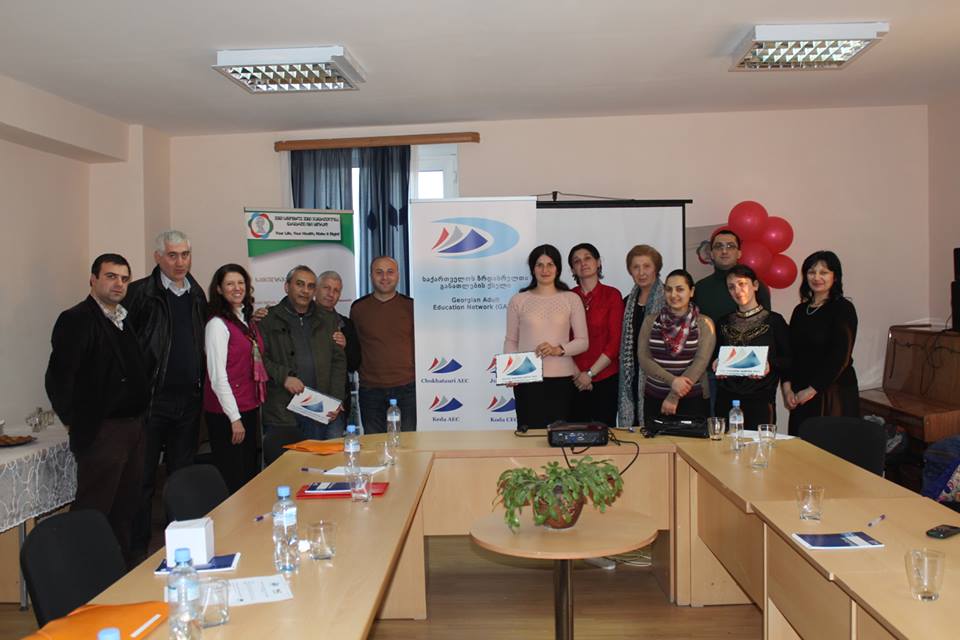
DVV works toward sustainability. Each year it opens new centers across Georgia, and challenges the existing ones to continue their good work,  through more of their own funding sources.  DVV sets up and initially funds an advisory network association that mentors, trains, leads, and fund raises for all the country's Centers, capitalizing on their economy of scale and strength in numbers.  GAEN is currently a network of 8 DVV Centers across Georgia which supports the Centers from a strategic planning level, all the way down to tactical management support.  Its value can not be underestimated as the Centers continue to develop into high functioning assets for their communities.  
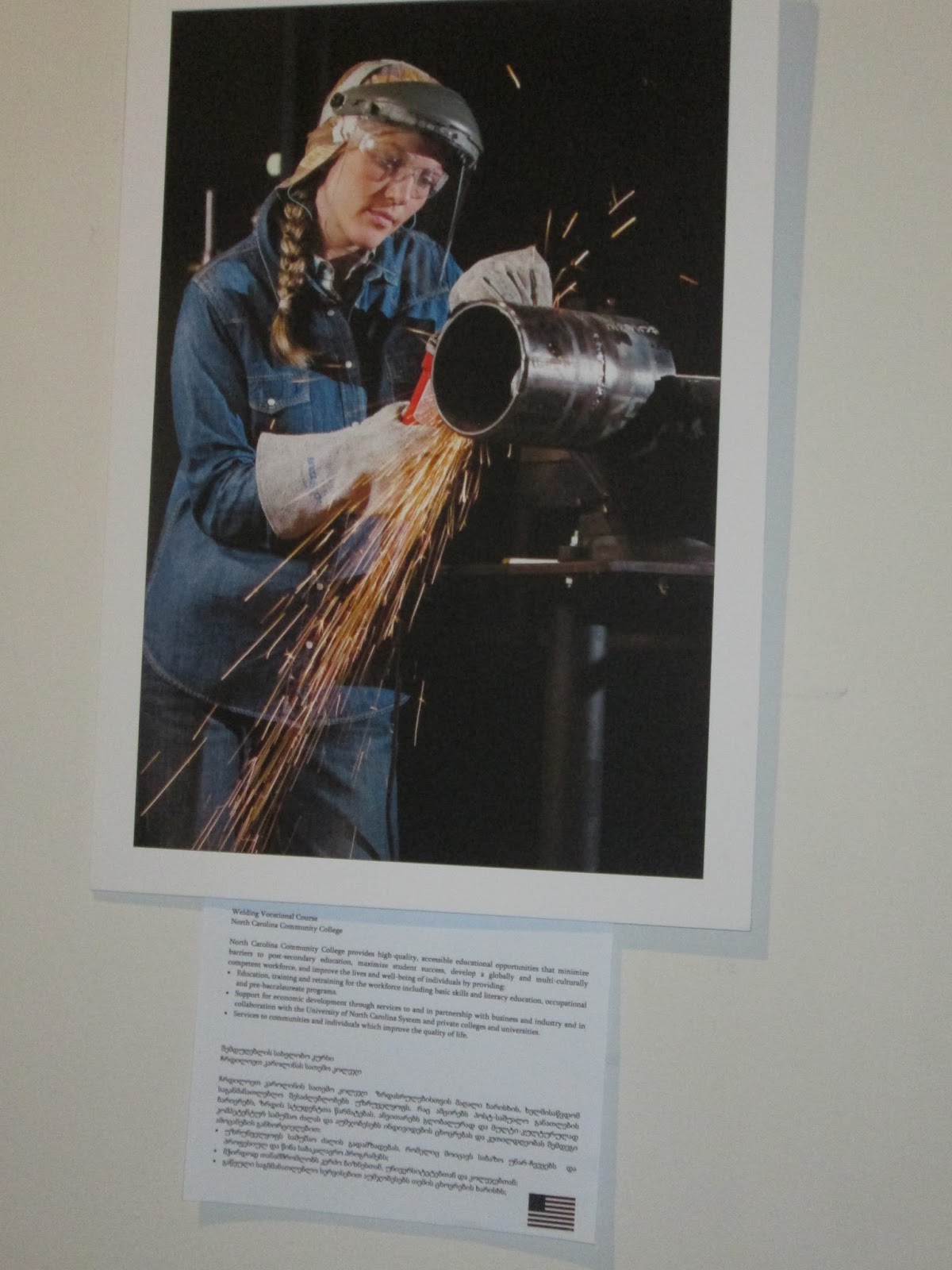
Adult culinary course in North Carolina
Khatia Tsiramua, former Koda CEC 
Director and founder and current GAEN Director
   
"It’s Never too Late to Learn!”was one project GAEN successfully completed last year.  Many of the embassies located in Georgia  displayed photos both of their home countries and of Georgia highlighting their activities supporting adult non-formal education. Even North Carolina State,  a  US  leader in adult education through its 58 Community Colleges, was represented. 

GAEN is also leading a very powerful Gender awareness project. This 18 month project has engaged 14 communities in the country. The focus is awareness of domestic violence, financial discrimination in the family, selective abortions and youth marriages. 


My Evolving Attitude
As a basic student of American idealism and pragmatism, I came to the Center focused on vocational education, and was delighted to learn that its founder was determined to support non-formal adult education. I can appreciate and support this basic education, helping to get people back on their feet with vocational training, and of course sustainable development, as well as the other lofty goals. However, I was struggling with the objective of enabling lifelong learning, and a specific project that was kicked off in many Georgian locations including Koda, focusing on lifelong learning for older residents. 

"Active for Life," funded by the EU, addresses learning by 60+ year old beneficiaries for personal development.  It included sharing music, literature, cooking, and photography.  Two popular elements of the program were the weekly visits by a psychologist and doctor.
Final group meeting with Psychologist Etuna

The Koda IDP settlement has many issues. Being in existence for eight years now, it still struggles with decent drinking water, limited, scheduled non-potable water supply for the apartments, poor soil and very limited irrigation for the small farm plots of these former agrarian neighbors, There is also high unemployment.   I could see a lot of needs in the settlement and the town as well where outside funding would help fix more pressing problems than learning just for learning sake -or so I thought.  So at first I was suspicious of this project.


Remembering and sharing 
old folk songs


One of the advantages of being a Peace Corps volunteer is that life slows down, if you let it.  Life can be simple. It is tiring attempting to understand local TV or movies. It is hard to continue with US hobbies, difficult to exercise. Time allows one the luxury to experience changes in attitudes, and Peace Corps allows us, no encourages us, to have the flexibility to change, even for us mature folks. Time allows us to challenge some basic, long held attitudes.  So I was mentally available to watch the outcome of the project and the gradual transition of the participants.   As the project continued, I could see a more positive attitude among the participants.  Those who were not as engaged in the community came forward with a heightened interest, seemed to become more friendly, relaxed and happy, less worried.  This feeling was contagious, and could be  replicated in their children, and grandchildren. 


As I pondered these changes, occurring during this program I was reminded of Maslow’s Hierarchy. His 1943 Theory of Human Motivation, studied in everyone’s college Psychology 101 class, suggests that the most basic level of needs must be met before the individual will strongly desire (or focus motivation upon) the secondary or higher level needs.


I would also like to mention  that in his later works he stated that the self only finds its actualization in giving itself to some higher goal outside oneself, in altruism and spirituality.

 Applying Maslow's Hierarchy to the Koda experience and the world of refugees, whether internally displaced or otherwise, we must remember that basic safety comes first.   When the Center first opened it helped to bring people out of their apartments and helped them overcome some of the initial fear since their abrupt and life changing ejection from S. Ossetia.  As time went on they were able to address higher level needs and wants. 

I assumed the most important thing I could do here was to teach people how  "to fish“ - how to get on with their lives through financial stability - jobs and new livelihoods.  But how can they have motivation to be creative and change careers as well as everything else they had known, to realize their full potential ( level 5) when they were still worrying about the stability of their housing, safety, healthcare,etc. (level 1 & 2)?

 
Life Long Learning 

The "Active for Life" program helped the participants regain some of their motivation. They felt more in control of their future and in regaining their self confidence. Near the end of the project, they had a performance in Tbilisi, at a local theater.  In the production, the participants played roles as if they were trying out for an international festival about to occur in Europe. They auditioned by song, dance and poetry.  It was delightful!


I see the change in my people here in Koda.  I see the renewed optimism. I see the motivation to get on with their lives.  After 8 years here, they are building garages, farming huts for livestock, gardens, stores and other businesses.  But without their basic level of needs satisfied, they would not be moving forward.  And I believe that DVV's focus on this personal development is as important as all their other goals.  Lali Santeladze, the Country Director for DVV, believes that the success of DVV here in Georgia is best demonstrated by that attribute most difficult to quantify, the changed attitude and spirit of its beneficiaries. And I have seen the success of this spirited motivation on a daily basis in Koda.   It has been a pleasure to serve with these good people at DVV and Koda Community Education Center, and I know they will continue to serve their community well. 


What's a project without a supra!


Madona, our Koda director, enjoying
her successful project!

Poems and Speeches

me... and my ladies


Wednesday, June 22, 2016

The Paravani Pass just Opened...


 What lucky timing.  My cousin from Budapest came to Tbilisi to attend a medical students association conference, and came early to visit me for a few days.  Orsi is so delightful, and she and her family have hosted our family in Budapest so often it was nice to reciprocate. Mike and Marcia, as usual,  had planned a great exploratory weekend and invited us. It is so nice to be on one of Mike's "adventures."


  We drove southwest from Koda to Tsalka and its beautiful Tsalka lake, and then up and over the Paravani Pass which is now open for the spring.
Tsalka

Chapel at the convent. 
We drove past Paravani Lake and stopped at the southern tip to visit a well known Orthodox convent where they sell "french" type cheese, candy, honey and other homemade delicacies. Poka has nothing in the village but the convent and few houses ( thus the sign, in English).
This is the national Georgian dog. Yes, you can ride some of them. 


Orsi with view from the pass


Khertvisi fortress on the way to Vardzia

Next we traveled northwest on our way to Vardzia. We drove past the stunning Khertvisi fortress, which is one of the oldest fortresses in Georgia and was functional throughout the Georgian feudal period.  It sits on a rocky hill at the confluence of the Mtkvari and Paravani Rivers. And more than that, in researching it,  I think it gives a great example of the history in Georgia.  For example, the fortress was first build in the 2nd century BC. The church was built in 985, and the present walls build in 1354. During the 12th century it became a town. In the 13th century Mongols destroyed it and until the 15th century it lost its power. In the 15th century it was owned  by a family and some repairs began. In the 16th century the southern region of Georgia was invaded by Turks. During next 300 years   Khertvisi was under Turkish control.  Then at the end of the 19th century Georgian and Russian army returned the lost territories and Khertvisi became the military base for Russian and Georgian troops.  Today it is on the list of tentative list of UNESCO World Heritage.

Vardzia is an amazing cave site, once inhabited by 50,000 people!
Hi Kaitlin and Jenny - bumped into fellow PCVs
getting the last of touring in before closing our service...soon.
We finally made it to Vardzia, a cave monastery site, excavated from the slopes of the Erusheti Mountain on the bank of the Kura River. Soviet-era excavations have shown that the area of Vardzia was inhabited during the Bronze Age. 
The main period of construction was the second half of the twelfth century. The caves stretch along the cliff for some five hundred metres and in up to nineteen tiers. The Church of the Dormition, dating to the 1180s during the golden age of Tamar and Rustaveli, has an important series of wall paintings. The site was largely abandoned after the Ottoman takeover in the sixteenth century.   I was surprised that we saw an incredible amount of work that had been done to capture rain water, in almost every room in the left side of the structure.  I don't remember that from our Mesa Verdi in the US. 


Orsi and Pam tunneling through Vardzia

Friday, April 15, 2016

Kvetera Church and Fortress


Kvetera Church sits within what remains of the Kvetera Fortress, near Akhmeta in the Kakheti region of Georgia.  Built in the early 900s, it is a relatively small church,with a four-apse cross, and four niches.  It isn't very fancy, and is common in Kakheti.  But this one was renovated in 2014 and is on the UNESCO World Heritage Tentative List.  I like the Tentative List - no tourists. Plus it is WAY out of the way, and a lovely weekend drive. It is so cool to picture a big palace and little church, and walls all around it for protection when the enemies come. Here are a few pictures.

Outside tower

Going inside the tower

Beautifully built stone circular staircase
 

Fortress on the left
Renovated church


10th century cistern

Lunch with friends


I am so appreciative of my 'city friends', and feel so lucky to have met a fun group of Americans and others that keep me sane sometimes.  This weekend was one of those times.  It was so interesting, relaxing, and just fun to be away and not struggle with post positions and georgian vocab.  Thank you all.  Then of course I miss my friends and neighbors in Koda, and can't wait to get back and see what new construction is going on, what new fields are being hoed, what new lambs, calves, piglets, puppies and bunnies are being born, and what new ideas and opportunities the locals here are asking about. Such vibrancy, and I can understand the language so much better now. WOW, at least some of the time.


Mike loves his waterfalls